
Navigating the New Era of RC Sourcing: An Insider’s Guide to the newly enforced China Drone Regulations and shifting global supply chain risks
As an industry veteran with over a decade of deep integration in China’s toy aircraft and remote control (RC) manufacturing hubs, I have watched our sector evolve through numerous technological waves. Today, however, we are experiencing a different kind of evolution—a regulatory one.
Recently, we have witnessed a massive, synchronized tightening of aviation and wireless regulations on both sides of the ocean. In China, sweeping low-altitude airspace management policies and strict mandatory national standards under the new China Drone Regulations have entered full enforcement. Meanwhile, the US Federal Communications Commission (FCC) has fundamentally re-engineered its equipment authorization rules, expanding its National Security “Covered List” to aggressively freeze the hardware architecture of the drone industry.
While many global importers might view these as separate, purely domestic administrative updates, their combined ripple effects are already reshaping the global toy supply chain. For international B2B distributors and retail buyers, navigating these changes requires a clear understanding of what happens behind the scenes. If your current product portfolio heavily relies on legacy GPS-enabled or camera-equipped toy aircraft, your supply chain is currently facing unprecedented structural bottlenecks at both the production and destination levels.
1. The Post-Assembly QC Dilemma: China’s “Blind Box” Sourcing Risk
Under the newly implemented China Drone Regulations, any flight platform fitted with a GPS positioning module, camera interface, or intelligent flight paths requires a rigorous digital real-time registration and network activation protocol before it can even unlock its motors.
For factories mass-producing consumer-level items, setting up standard open-air, pre-shipment flight testing—which is absolutely vital for proper quality control (QC)—has become an administrative and legal minefield. Turning on a GPS-enabled drone outside the workshop immediately pings local low-altitude flight monitoring networks. Conducting these tests without unauthorized airspace clearance results in severe penalties and administrative shutdowns for the facility.
The Operational Shift: Because navigating these local permissions for high-volume batches is logistically impossible for most traditional vendors, some manufacturers have quietly altered their quality control workflows. Outdoor GPS satellite searching and actual open-sky flight stability tests are being skipped entirely. Drones are briefly powered up indoors for basic component checks and packed straight into shipping cartons.
For overseas buyers, this means you are importing “blind boxes.” The risk of receiving cargo with severe calibration issues, compass errors, or motor synchronization faults naturally skyrockets, leading to an unexpected surge in consumer return rates in your local retail markets.
2. The Export Logistics and Port Predictability Bottleneck
Simultaneously, Chinese customs authorities have optimized export compliance audits regarding civil flight platforms and dual-use items. Aircraft featuring advanced communication arrays, long-range capabilities, or integrated imaging systems are receiving exhaustive scrutiny at the ports.
If a supplier’s manufacturing infrastructure is exclusively set up for these regulated, high-risk categories, adapting their core product architecture takes months. One minor documentation discrepancy or an extended custom clearance audit can tie up your containers at the port for weeks—causing you to completely miss critical seasonal retail windows.
3. The US FCC Drone Ban: The Sudden Freeze on New Product Pipelines
While traditional suppliers are struggling with production (QC) and export blockades in China, their future pipeline is facing an absolute freeze at the US border. The US FCC has enacted a sector-specific expansion of its “Covered List,” creating a sweeping prohibition: the FCC will no longer review, accept, or approve any new equipment authorizations (FCC ID) for foreign-produced Uncrewed Aircraft Systems (UAS) and “UAS critical components.”
The Silicon and Hardware Trap: This ban explicitly blankets “UAS critical components”—covering everything from flight controllers, navigation/GPS modules, and RF data transmission devices to specialized motors and battery management systems.
If a supplier’s entire catalog is built around legacy GPS flight schemes, they are structurally blocked from obtaining FCC IDs for any upcoming models or newly optimized variations. Many factories are quietly burning through older, previously authorized inventory while keeping their overseas clients in the dark about the fact that their new product R&D is functionally locked out of the US market. Importing or marketing an unauthorized wireless device in the US carries massive legal liabilities, risking immediate customs seizures and catastrophic financial penalties for global distributors.
The X-VIKI Solution: Engineering for the Portfolio-Wide “Regulatory Sweet Spot”
Years ago, anticipating this global tightening of low-altitude airspace laws and wireless compliance, we adopted a different curation philosophy at X-VIKI. We realized that true commercial sustainability in the consumer toy sector doesn’t come from over-engineering products into regulatory gray areas, but from delivering high perceived value creative play with absolute regulatory immunity.
This forward-thinking blueprint isn’t just limited to a single showcase item; it is the underlying architecture of the entire X-VIKI fleet.
Whether you are looking at our award-winning Terra-Flier T1 or exploring the rest of our curated RC and robotics product lines, every single item in our portfolio is engineered from the ground up to sit perfectly within the global regulatory sweet spot: Weight strictly under 250g, No GPS, and No Camera.
By engineering our entire fleet to completely bypass the legal restrictions of the China Drone Regulations, X-VIKI ensures that our global partners receive distinct, X-VIKI ensures that our global partners receive distinct, portfolio-wide structural and logistical advantages:
- Uncompromised, Portfolio-Wide QC: Because our entire product line completely circumvents digital registration and airspace tracking requirements, our manufacturing partners can perform standard, rigorous outdoor flight and motion testing safely and legally. The quality is 100% verified across all models before any container is sealed.
- Green-Channel Customs & Predictable Logistics: Every item enters global trade channels strictly as a 100% pure “Toy Category” commodity. This entire-line compliance completely avoids complex dual-use export control audits, ensuring your logistics timeline remains ironclad and predictable across all seasonal product shipments.
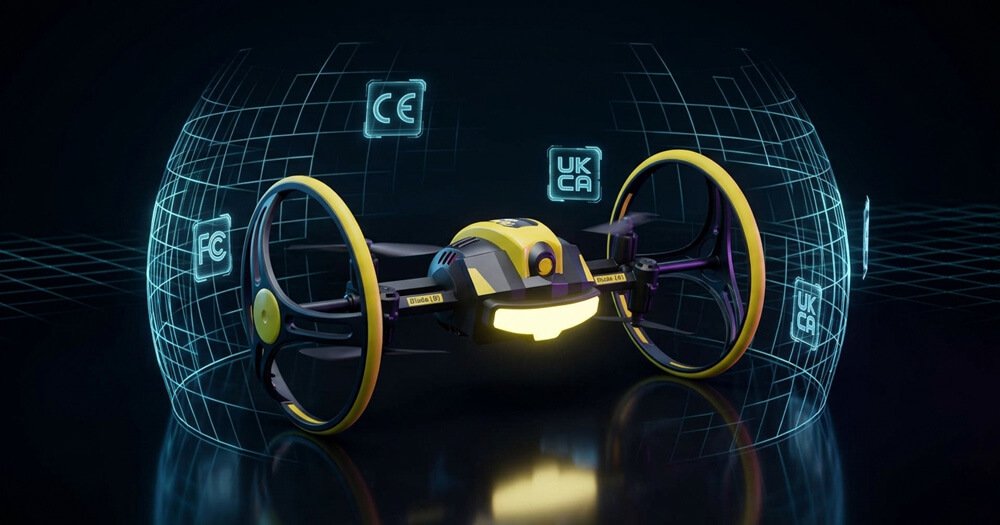
- Bulletproof Certification & Global Retail Access (CE, UKCA, FCC Certified): Unlike legacy vendors currently locked out by evolving rules, our core product lines have fully secured official CE, UKCA, and FCC certifications. This proves that our entire supply chain is 100% clean, utilizing compliant 2.4GHz consumer wireless chipsets entirely untainted by global restriction lists. Combined with the sub-250g blueprint, our fleet offers portfolio-wide double protection: it is completely exempt from consumer registration or licensing hassles (FAA/EASA), while being legally fully-authorized for immediate, large-scale commercial distribution across North America, the UK, and Europe.
Award-Winning Innovation Over Regulatory Burden
We have always believed that removing regulatory complexity should never mean sacrificing the “wow” factor for the end consumer. Proving this balance, the Terra-Flier T1 was proudly recognized as a WINNER & NOMINEE at the ToyAward 2026. Its 3-in-1 hybrid design—proving that creative play-modes far outperform high-risk tech gimmicks—seamlessly transitions between an agile drone, a ground crawler, and a bouncing rover, providing high-margin novelty without any of the compliance baggage. And that same spirit of non-commodity, highly creative differentiation is built into every other RC vehicle we curate.
In today’s sourcing landscape, a strategic manufacturing partner shouldn’t just deliver a single product; they should safeguard your entire supply chain stability and offer a growing, compliant product roadmap.
If you are currently reviewing your product lines for the upcoming seasons and want to transition away from high-risk GPS suppliers toward a partner that offers absolute compliance, portfolio-wide quality predictability, and award-winning innovation, let’s connect.
Contact the X-VIKI team today to explore our full, fully-certified RC fleet and secure your risk-free production allocation.